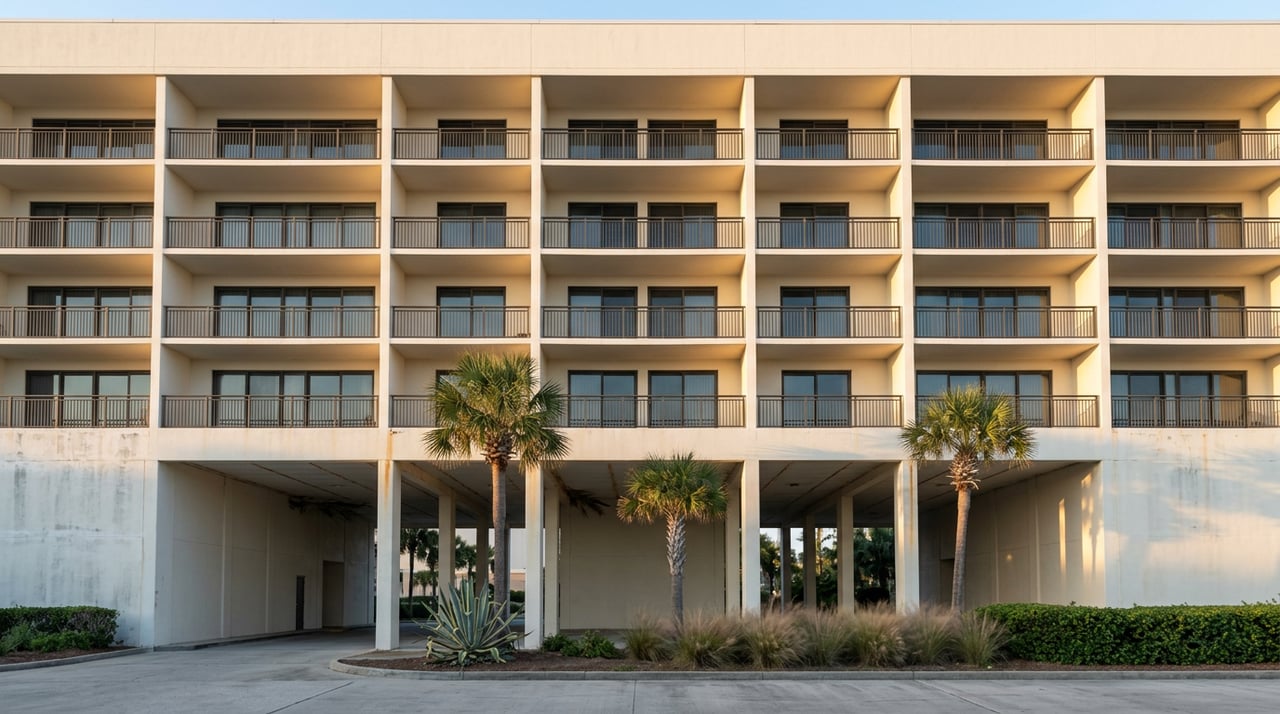
Two oceanfront-adjacent condos are on the market right now within a few blocks of each other, priced within a few thousand dollars of one another. Same era, similar square footage, similar HOA amenities on paper. A buyer scrolling listings would have no reason to treat them differently.
But one of these units sits inside a specific strip of blocks running from 29th Avenue South to 82nd Avenue North, east of Kings Highway. The other sits just outside that line. That line is not decorative. It determines whether the next owner of one of these units will ever be allowed to rent it long-term, and it's about to collide with a separate federal financing rule that could determine whether either unit can be financed conventionally at all. Two structural forces, moving independently, are quietly deciding which Myrtle Beach condos stay liquid and which ones don't.
The Ordinance That Draws the Line
Myrtle Beach City Council voted unanimously on December 10, 2024 to adopt Ordinance No. 2024-69, creating what the city code calls the Short-Term Rental Conversion Overlay Zone under Section 1808. The zone covers commercial districts east of Kings Highway, and its purpose, as written, is to preserve tourist accommodations along the oceanfront rather than let them drift into apartment-style long-term housing. In any building of more than two units that was built or used as a visitor accommodation inside that zone, a unit cannot be rented or leased for 90 continuous days or more. The code closes the obvious workaround, too: stacking back-to-back leases under 90 days each so one tenant effectively stays longer is itself a violation.
There are carve-outs. Owners who already held a business license for long-term rental before the ordinance passed can keep operating that way as long as the license stays current. Assistant City Manager Brian Tucker, addressing a specific scenario at the December 2024 meeting, explained that if a unit had been someone's primary residence and they later sold it, the next buyer wanted to operate it as a rental, "the next buyer wants to operate it as a long-term, they would be able to do that." Outside of narrow exceptions like that one, though, a unit inside the zone that has ever operated as a visitor accommodation is committed to short-term use going forward.
Why the City Drew It There
The overlay didn't come from nowhere. In April 2024, the city placed a 270-day moratorium on converting short-term rental buildings to long-term use while it studied the impact. Urban planning firm Arnett Muldrow and Associates found that converting 1,000 rental rooms from short-term to long-term would cost the city $2.5 million, Horry County $1.2 million, and the state $3.9 million, a combined $7.6 million loss in accommodations taxes, prepared food and beverage taxes, and business license fees. That's the number city leaders were protecting when they made the overlay permanent instead of letting the moratorium lapse in January 2025.
Not everyone agreed with the approach. One resident, reading a message on behalf of a friend who couldn't attend the meeting, called the ordinance disproportionate, comparing it to "using a sledgehammer to hang a picture." The frustration is understandable from an owner's side. The tax logic is understandable from the city's side. Both things can be true, and a buyer weighing a unit inside this zone needs to hold both at once: the city has a strong financial reason to keep this rule in place, and that means it's not a rule likely to loosen soon.
What the Overlay Zone Is Actually Protecting
Look at what's happened to the short-term rental market itself and the logic behind the ordinance starts to make more sense. As of July 2026, Myrtle Beach had roughly 19,903 active short-term rental listings, down 6.0% from a year earlier. Average annual revenue per listing slipped 2.3% to $26,100, and occupancy fell 5.3% to 53%. But the average daily rate climbed 8.4% to $280. Fewer listings, softer occupancy, higher nightly rates. That's not a market in decline. It's a market where inventory is contracting and the units that remain are commanding more per booked night.
The overlay zone is one reason that contraction is orderly rather than chaotic. By preventing wholesale conversion of oceanfront towers to apartments, the city has kept the supply of visitor accommodations from shrinking any faster than it already is. For an investor, that's a mixed signal worth sitting with rather than resolving too quickly. Scarcity is propping up rate. It is not propping up occupancy. A unit's income story in 2026 depends more on rate management than on filling every night of the calendar the way it might have three or four years ago.
The Rule on the Other Side of the Ledger
Here's where a second, unrelated rule enters, and where the real friction shows up for anyone financing a purchase rather than paying cash. Fannie Mae and Freddie Mac issued Lender Letter LL-2026-03, which caps a condo master insurance policy's per-unit deductible at $50,000 for any loan application dated on or after July 1, 2026, replacing the old standard of 5% of coverage. On an older oceanfront tower with a master policy still written as a percentage deductible, that flat cap can be brutal in dollar terms. A 3% deductible on a $20 million policy works out to $600,000, twelve times the new limit. If the board doesn't renegotiate the policy before the next loan application comes through, every buyer in that building loses access to conventional financing until it does.
The reserve requirement is tightening on a similar timeline. Fannie Mae's replacement-reserve minimum rises from 10% to 15% of annual assessment income for loan applications dated on or after January 4, 2027. Buildings that fall short lose warrantable status, and non-warrantable buildings only qualify for portfolio or DSCR loans, which generally require 20% to 30% down and carry interest rates one to two percentage points above conventional financing. None of this is retroactive to loans already closed. It shows up the next time someone tries to buy into the building or refinance an existing unit.
| Warrantable Building | Non-Warrantable Building | |
|---|---|---|
| Financing available | Conventional (Fannie/Freddie) | Portfolio or DSCR loans only |
| Typical down payment | As low as 10-20% | 20-30% |
| Rate premium | None | 1-2 points above conventional |
| Buyer pool at resale | Broad | Narrower, slower sales |
That last row is the one that matters most to a seller. Fewer financeable buyers means longer marketing periods and softer offers, regardless of how strong the rental numbers look on paper.
The Double Bind
This is where the two rules meet, and it's the thing a listing sheet will never tell you. A unit inside the STRC Overlay Zone is legally committed to short-term rental use. If that same building's master policy has an outdated deductible structure or thin reserves, it's also at risk of losing conventional financing eligibility under the 2026 and 2027 Fannie Mae and Freddie Mac rules. Put those together and you get a unit that cannot pivot to long-term rental for cash flow stability and cannot count on a full buyer pool if the board hasn't already fixed its insurance and reserve position. That's a double bind, not a single risk, and it's specific to buildings east of Kings Highway that haven't kept their master policy current.
The inverse is also true. A well-managed building inside the overlay zone, one that has already restructured its deductible below $50,000 and is funding reserves at 15%, holds a genuinely defensible position: locked-in tourist accommodation status in a zone the city has committed to protecting, financeable to a broad buyer pool. The overlay zone and the lending rule aren't pulling every building in the same direction. They're separating strong-fundamentals buildings from weak ones faster than either rule would on its own.
Before writing an offer on any oceanfront unit in this zone, request:
- The current HOA condo questionnaire, which summarizes reserves, delinquencies, insurance, and investor concentration in one document
- The master policy declarations page, specifically the per-unit deductible figure in dollars, not percentage
- The most recent reserve study and the percentage of annual budget currently allocated to reserves
- Board meeting minutes from the last twelve months for any mention of pending special assessments or insurance renewal difficulty
Quick Answers Before You Write an Offer
Does the overlay zone affect single-family homes? No. Section 1808 applies specifically to buildings of more than two units, constructed or used as visitor accommodations, inside the commercial districts east of Kings Highway. A single-family home outside that footprint isn't subject to it.
What if my building's master policy renews before July 2026? The $50,000 deductible cap applies to loan applications dated on or after July 1, 2026, not retroactively to loans already closed. A building that renews its policy under the old structure right before that date buys itself time, but the exposure returns at the next sale or refinance once a new application is filed.
Can I buy a unit in the overlay zone if I plan to live there full time? Yes. The overlay zone restricts what the building can be rented as, not whether an owner can occupy it as a primary or seasonal residence. The restriction only becomes relevant if and when that owner decides to rent the unit out.
Every condo tower on the Grand Strand is telling a slightly different version of this story right now, and the only way to know which version applies to a specific building is to read its actual financials rather than its finish list. That's the kind of comparison our team runs before a client ever writes an offer. If you're weighing an oceanfront purchase against a second-row alternative, reach out to The Brian Piercy Group and we'll pull the HOA documents and financing picture on the specific buildings you're considering.