If you are eyeing a Garden City oceanfront condo for rental income, the big question is simple: do the numbers work well enough to justify the price, risk, and seasonality? The answer is often yes, but not evenly across every unit, building, or owner strategy. In Garden City, short-term rental performance depends on a mix of oceanfront appeal, sleeping capacity, amenities, building rules, and careful cost planning. Let’s dive in.
Garden City has strong rental demand drivers
Garden City Beach benefits from its place inside the larger Myrtle Beach area, a 60-mile tourism corridor that attracts more than 17 million visitors each year, according to Visit Myrtle Beach. That broad tourism base helps support short-term rental demand well beyond a single holiday window.
The area also benefits from weather that supports a longer booking season. Visit Myrtle Beach reports an average annual temperature of 73°F and about 215 sunny days, which helps explain why Garden City can draw both peak summer travelers and shoulder-season visitors.
Just as important, guests are not booking only for the beach. The Pier at Garden City, Murrells Inlet MarshWalk, and Brookgreen Gardens all add activity options that can widen the appeal of an oceanfront condo stay throughout more of the year.
What Garden City condo performance looks like
Public short-term rental data points to a market with real income potential, but also clear seasonality. AirROI’s 2026 snapshot for the broader Garden City Beach STR market shows average annual revenue of $39,117, average occupancy of 40.8%, an average daily rate of $363, and RevPAR of $157.
Those numbers are useful as a starting point, not a promise for any single condo. They show that Garden City can support meaningful revenue, but they also show that occupancy is not flat across the year.
Seasonality is especially important here. AirROI identifies July as the peak revenue month and January as the softest month, which lines up with what many coastal owners already expect from a beach-driven market.
A broader regional cross-check supports that pattern. Visit Myrtle Beach reported about 70% summer occupancy for hotels and STRs combined in June through August 2025, while its industry research page reports 41.3% average occupancy for vacation rentals in 2024 across the Grand Strand.
The spread between average and top performers is wide
One of the most important takeaways for investors is that not all oceanfront condos perform alike. AirROI shows a large gap between the average listing and the strongest listings in the market.
According to that 2026 snapshot, the top 10% of listings earn more than $9,845 per month, while the median is about $3,192 per month and the bottom quartile is about $1,709 per month. That spread tells you something critical: owning in Garden City is not enough by itself.
To reach stronger results, the condo has to compete on the details that matter most to vacation renters. In this market, that usually means location, view, layout, amenities, convenience, and management quality all working together.
Larger condos often have an edge
Garden City’s short-term rental market leans toward group and family travel. AirROI says 70.1% of Garden City Beach listings accommodate six or more guests, and 38.9% accommodate eight or more guests.
That matters when you compare condo floor plans. A two-bedroom oceanfront unit can absolutely perform well, but larger units may have a better shot at peak-week family demand if the building and layout support comfortable occupancy.
One Ocean Place offers a useful example of how occupancy limits affect positioning. Its HOA rules cap occupancy at 6 for two-bedroom units, 8 for three-bedroom units, and 10 for penthouses. In practical terms, larger floor plans may appeal to a wider slice of the summer rental market when travelers are booking for shared beach trips.
Amenities can lift booking appeal
In a crowded coastal market, guests often compare properties quickly. That means building amenities can play a direct role in whether your condo stands out and whether you can support stronger nightly rates.
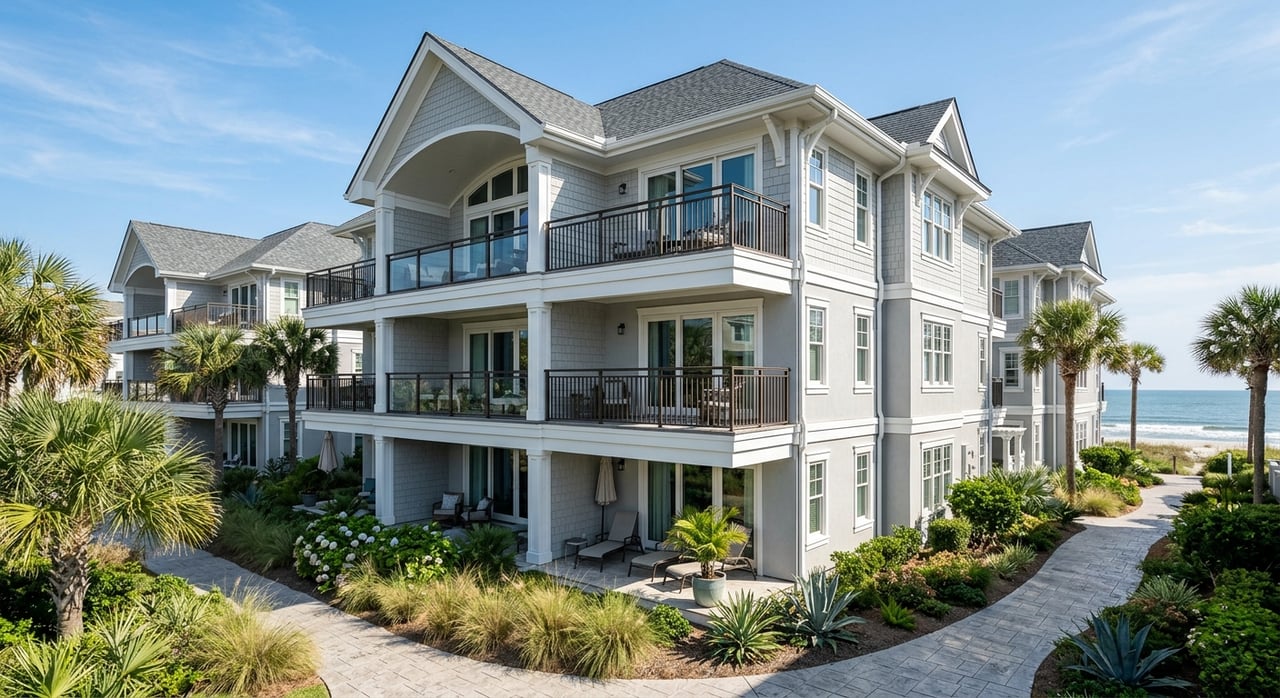
At One Ocean Place, advertised amenities include direct oceanfront positioning, private balconies, two outdoor pools, two outdoor Jacuzzis, a private lounge, and a gym for owners. Water’s Edge Resort highlights indoor and outdoor pools, a lounge, fitness center, gift shop, oceanfront café, covered parking, security, and Wi-Fi.
These features matter because they add convenience and flexibility to the guest experience. For many travelers, especially families and groups, a condo that offers pools, parking, easy beach access, and on-site extras can be easier to market in both the summer peak and shoulder seasons.
Building rules can affect your guest pool
Not every factor that shapes rental performance is visible in a listing photo. HOA and building rules can also influence who books and how smoothly the property operates.
For example, One Ocean Place prohibits trailers and golf carts, limits parking permits to two per rental unit, and restricts pets and smoking. Rules like these may help protect the building and simplify operations, but they can also narrow the pool of travelers compared with a detached house that offers more flexibility.
That does not make condo ownership less attractive. It simply means your underwriting should account for how building policies may influence guest fit, marketing strategy, and repeat booking potential.
Taxes and licensing affect net income
Gross revenue is only part of the story. If you are evaluating a Garden City oceanfront condo as a short-term rental, you also need to understand the local tax and licensing framework because it affects your real bottom line.
South Carolina says accommodations tax applies to rentals of less than 90 continuous days. The state also says direct-booking hosts need a Retail License, while properties rented exclusively through a property manager or online travel agency are generally handled by that intermediary for tax remittance.
Horry County also requires a Business License for businesses operating in unincorporated areas and charges a Hospitality Fee on transient accommodations. The applicable rate depends on whether the property is inside or outside municipal limits.
For an investor, these are not side notes. They should be built into your underwriting from day one because they change your after-tax cash flow.
Coastal risk needs to be part of underwriting
Oceanfront income comes with oceanfront risk. In Garden City, that means you should evaluate not only rental demand, but also weather disruption, insurance cost, and reserve planning.
The South Carolina hurricane plan places Horry County coastal areas, including coastal areas of Garden City, in evacuation Zone A. That matters because storm threats can interrupt bookings, create last-minute cancellations, and affect seasonal operations.
SCDES also identifies the Garden City shoreline as moderately erosional and notes that seasonal changes, coastal storms, and extreme high tides can dramatically change beach profiles. For owners, that makes it wise to look closely at insurance, reserves, and building condition rather than relying on revenue projections alone.
What this means for buyers and sellers
If you are a buyer, Garden City oceanfront condos can be attractive short-term rental assets, but the best opportunities are usually not the ones judged by view alone. You want to compare sleeping capacity, amenities, parking, building rules, tax setup, and seasonal risk before you project income.
If you are a seller, this market data reinforces the value of positioning. Because the spread between average and top-tier performance is so wide, strong marketing, clear revenue framing, and polished presentation can help your condo stand out with investor and second-home buyers.
In other words, Garden City can work very well as a short-term rental market, but it rewards precision. The units that tend to perform best combine direct oceanfront access, family-friendly capacity, appealing amenities, and disciplined ownership or management.
When you are ready to evaluate a condo’s rental potential or position an oceanfront property for the market, The Brian Piercy Group can help you make a more informed move.
FAQs
How much do Garden City Beach short-term rentals make on average?
- AirROI’s 2026 snapshot shows average annual revenue of $39,117 for the broader Garden City Beach STR market.
Are Garden City oceanfront condos seasonal as short-term rentals?
- Yes. AirROI identifies July as the strongest revenue month and January as the softest, showing clear seasonality.
Do larger Garden City condos perform better as rentals?
- Larger condos may have an advantage because the local market leans toward group travel, with 70.1% of listings accommodating six or more guests.
What condo features help Garden City rentals compete?
- Direct oceanfront access, private balconies, pools, parking, fitness amenities, and convenient on-site features can improve guest appeal and support stronger pricing.
Do Garden City short-term rentals have local tax and license requirements?
- Yes. South Carolina applies accommodations tax to rentals under 90 continuous days, and Horry County requires a Business License in unincorporated areas and charges a Hospitality Fee on transient accommodations.
What coastal risks should Garden City condo buyers consider?
- Buyers should account for hurricane disruptions, insurance costs, reserve planning, and shoreline conditions, especially since coastal Garden City is in evacuation Zone A and the shoreline is described as moderately erosional.